
Hydraulic Cylinder Specs Decoded: Manufacturing Quality Impact
Hydraulic Cylinder Specs Decoded: Manufacturing Quality Impact
When sourcing industrial hydraulic cylinders, procurement professionals often face a critical challenge: how to interpret technical parameters and understand how manufacturing processes directly influence product quality, reliability, and total cost of ownership. This guide provides a systematic framework for decoding specifications and evaluating production capabilities, helping you make informed purchasing decisions for harsh environment applications.
The Problem: Why Technical Parameters Need Context
A datasheet listing bore diameter, rod diameter, stroke, and pressure rating tells only part of the story. Without understanding the manufacturing choices behind those numbers—material selection, heat treatment, welding procedures, surface coating, and testing protocols—you risk selecting a cylinder that fails prematurely in marine, metallurgical, or hydropower applications.
- Bore & Rod Dimensions: Determine thrust and pulling force. But material and heat treatment dictate load cycle life.
- Working Pressure: A high rating means little if sealing design or cylinder wall thickness cannot sustain pressure peaks.
- Stroke Length: Long strokes require stability analysis to prevent rod buckling—a factor often overlooked in standard catalogs.
- Surface Coating: Chrome plating vs. ceramic coating dramatically changes corrosion resistance and wear behavior.
Industry Background: The Cost of Ignoring Manufacturing Quality
Industrial hydraulic cylinders operate in extreme conditions: salt spray offshore, high temperature in steel mills, particulate contamination in mining, and cyclic loads in water gates. A cylinder that fails in the field causes costly downtime, safety risks, and replacement expenses. For non-standard customizations—common in marine oil cylinders, metallurgical cylinders, and hydropower servomotors—the link between manufacturing quality and field performance becomes even more critical.
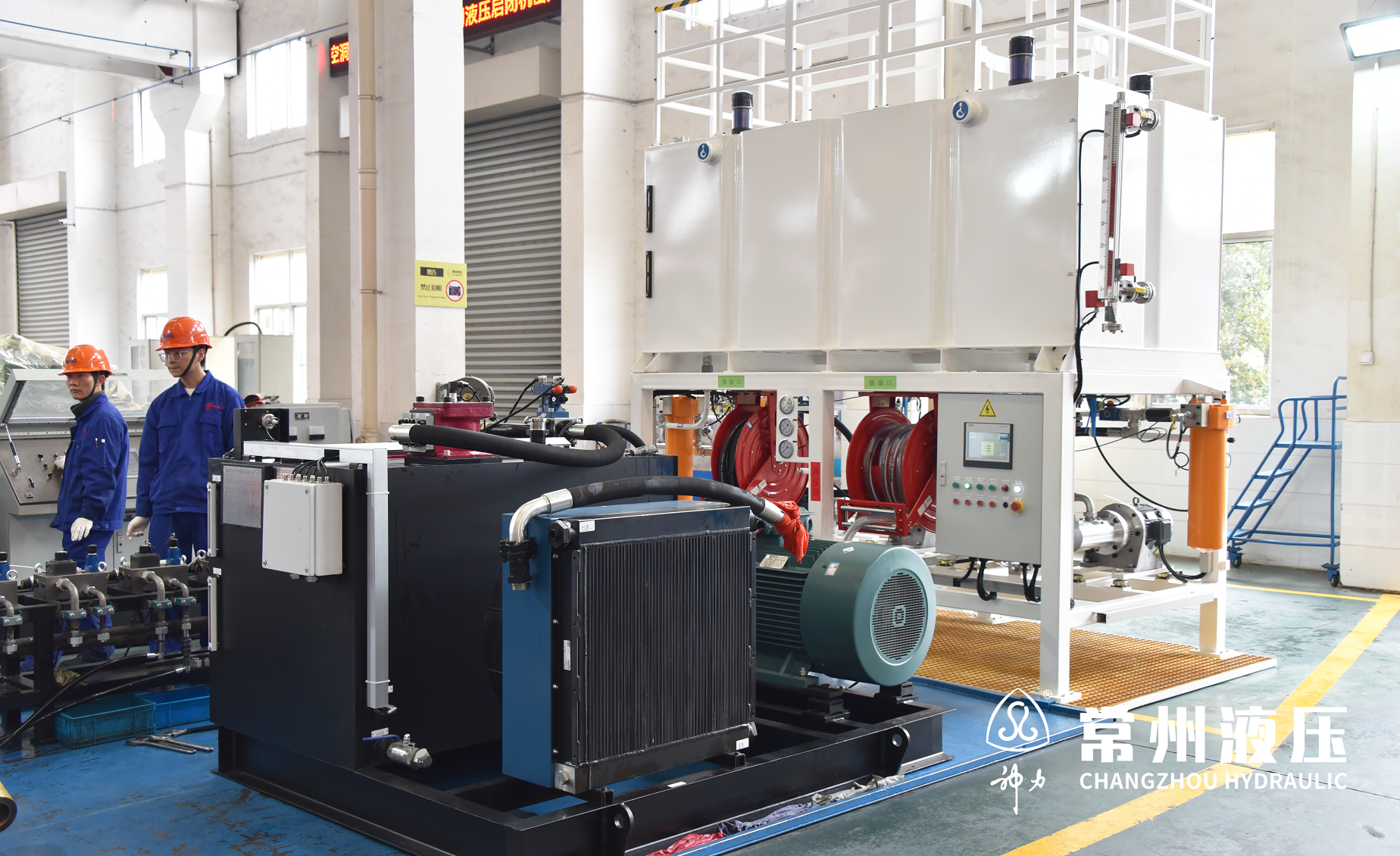
Figure: A comprehensive testing platform ensures every hydraulic cylinder meets performance specifications before shipment.
Detailed Solution: Interpreting Key Parameters & Their Manufacturing Implications
1. Material Selection & Heat Treatment
The piston rod is typically made of quenched and tempered steel (45# or 40Cr) with medium-frequency induction hardening (HRC55-60) and hard chrome plating (≥0.03mm). For aggressive environments, stainless steel (316L) or ceramic coating via thermal spray is preferred. The cylinder barrel uses precision cold-drawn tubing (e.g., 27SiMn) with honed inner walls. Why it matters: Hardness depth and uniformity prevent rod bending; barrel straightness ensures seal longevity.
2. Welding & Non-Destructive Testing
Welded cylinder bases and end caps must undergo ultrasonic or magnetic particle inspection to eliminate hidden cracks. A supplier with ISO 9001:2015 certification (e.g., Changzhou Hydraulic, certificate No. 02024Q1295R6M) demonstrates adherence to controlled welding procedures and 100% testing.
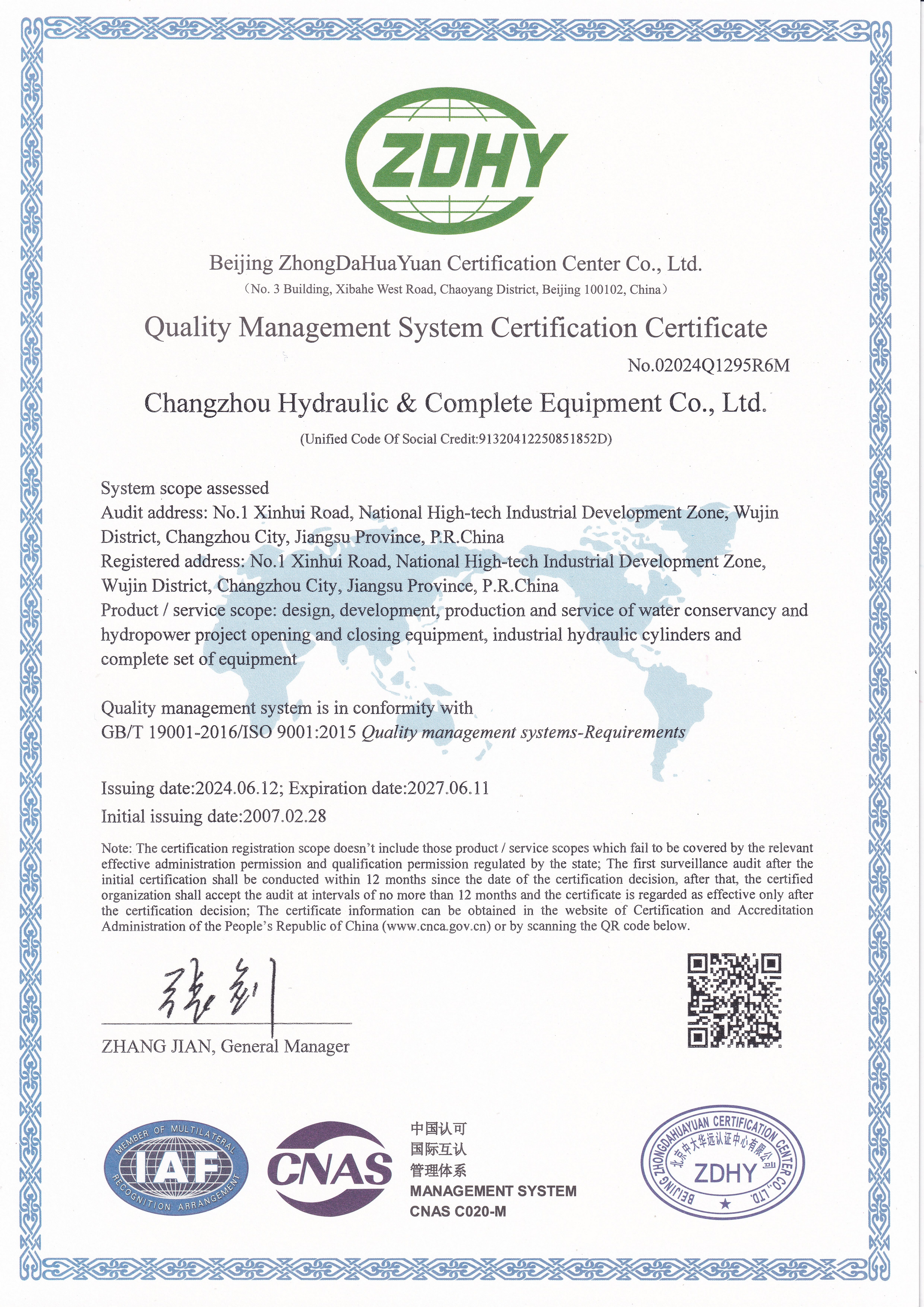
Figure: Quality Management System certificate verifying controlled manufacturing processes.
3. Surface Coating: Chrome vs. Ceramic
Traditional hard chrome plating is susceptible to pitting, hydrogen embrittlement, and peeling in marine climates. Advanced ceramic coating (HVOF or plasma spray) offers:
- No risk of hydrogen embrittlement
- Higher dimensional stability
- Eco-friendly, non-toxic properties
- Up to 30% reduction in total cost of ownership through longer service life and less maintenance
This technology is ideal for offshore hydraulic cylinders, ocean engineering cylinders, and marine applications where salt spray resistance is paramount.
4. Installation Alignment & Buffer Design
Misalignment causes eccentric wear. Professional manufacturers provide spherical bearings or joint bearings to compensate for installation errors. Buffer adjustments at the end of stroke prevent shock loads that can crack cylinder heads.
Step-by-Step: How to Evaluate a Supplier's Manufacturing Quality
- Request Material Certificates: Verify chemical composition and mechanical properties of rod and barrel.
- Check Surface Coating Specifications: Ask about coating thickness, adhesion test methods, and salt spray resistance hours.
- Review Testing Procedures: Look for 100% hydrostatic testing, endurance testing, and functional testing at rated pressure.
- Audit Factory Capabilities: CNC machining centers, honing machines, and comprehensive test platforms (like the one at Changzhou Hydraulic’s 10,000m² facility) indicate production maturity.
- Validate Certifications: ISO 9001, ISO 14001, ISO 45001, and product-specific standards (e.g., GB/T9001-2000) provide a quality baseline.
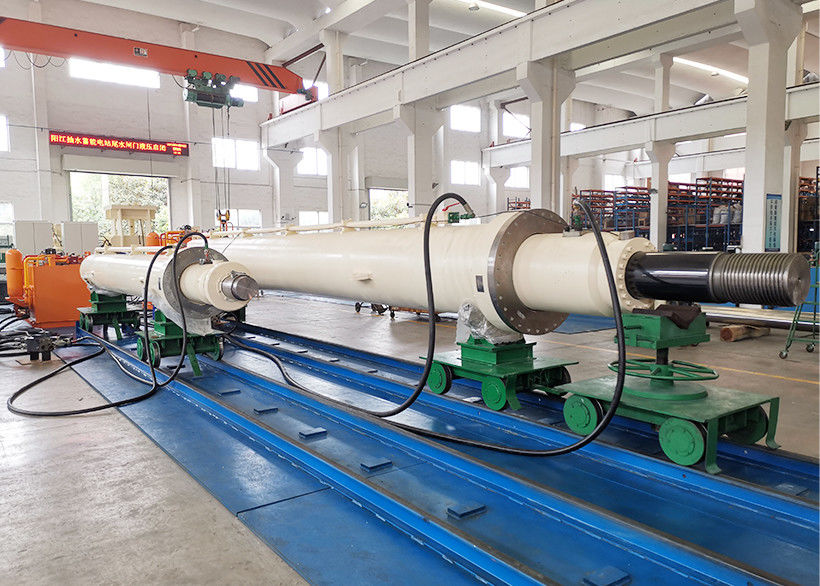
Figure: A large-bore flat gate hydraulic cylinder (max diameter 1200mm) designed for water conservancy applications, manufactured under ISO 9001 processes.
Real-World Case: Precision in Hydropower Gate Hoists
Changzhou Hydraulic supplied a complete hydraulic hoist system for a pumped storage power station. The design specification required a holding force of 5000 kN to quickly close the tailrace emergency gate under fault conditions. The gate slot cover plate—integrating numerous precision devices—achieved a flatness error strictly controlled within 0.05 mm per square meter, ensuring a seamless fit. This level of precision is only possible through rigorous manufacturing control, including honed cylinder bores, certified welding, and 100% factory testing.
Frequently Asked Questions
Q: What is the most important parameter for a hydraulic cylinder in a harsh environment?
A: Corrosion resistance often determines service life. For offshore or marine applications, prioritize rod coating (ceramic over chrome) and sealing materials (polyurethane or PTFE).
Q: How does manufacturing quality affect total cost of ownership?
A: A cylinder with superior material treatment, precise machining, and thorough testing may cost 20-30% more upfront, but can reduce maintenance costs by 40% and extend lifespan by 2-3x, yielding lower TCO.
Q: How do I verify a supplier's claimed manufacturing capabilities?
A: Request factory audit, review certification scopes (e.g., ISO 9001 for design & production), ask for test reports from third-party labs, and check references from similar industries (marine, metallurgy, hydropower).
Q: What is the difference between single-acting and double-acting cylinders for hoist applications?
A: Single-acting cylinders use hydraulic pressure for extension and rely on gravity or springs for retraction; double-acting cylinders provide powered motion in both directions. The choice depends on gate type and control requirements.
Conclusion
Decoding hydraulic cylinder specifications requires more than reading numbers—it demands understanding how manufacturing processes transform those numbers into reliable performance. By evaluating material quality, surface treatment technology, testing rigor, and facility capabilities, you can select a professional manufacturer of industrial hydraulic cylinders that delivers value under the toughest conditions.
For a comprehensive overview of technical parameters, manufacturing capabilities, and case studies, download our company brochure or contact our engineering team at zzl@czhydraulic.com.
Have Questions or Need More Details?
Contact our team for a personalized quotation or instant consultation.
Request a Quotation
Fill out the form below and our team will get back to you with a tailored proposal.
WhatsApp Direct Chat
Prefer to chat in real-time? Message us on WhatsApp for instant assistance & quick answers.
- Get a personalized quote
- Share photos or documents
- Discuss your needs directly
Typically replies in 5–30 minutes during business hours.