Carbon Steel vs. Stainless Steel Hydraulic Cylinders: A Head-to-Head Decision Guide
Carbon Steel vs. Stainless Steel Hydraulic Cylinders: A Head-to-Head Decision Guide
Body material is the first specification that locks an industrial hydraulic cylinder into a maintenance profile — and usually the last one buyers revisit. A marginally wrong material choice rarely fails at commissioning. It fails two or three service intervals later, as corrosion pitting on the barrel, degraded seals, scored rods and unplanned downtime that no warranty conversation fully pays for.
This guide sets the two most common options head-to-head: carbon steel versus stainless steel cylinder bodies, with alloy steel positioned as the middle path. The comparison runs across the four criteria that determine lifecycle cost — corrosion exposure, load requirements, maintenance cycles and procurement terms. Material and certification facts are drawn from Changzhou Hydraulic Complete Equipment Co., Ltd (trading as CZHydraulic), a hydraulic cylinder manufacturer based in Changzhou, Jiangsu Province, China, whose industrial hydraulic cylinders are produced in carbon, alloy or stainless steel.
Problem Definition: What the Carbon vs. Stainless Decision Actually Controls
Most material debates start with strength and end in the wrong place. Strength is rarely the binding constraint; corrosion exposure and maintenance access usually decide the outcome long before yield values matter. Breaking the decision into four controlled variables makes the trade-off measurable.
- Barrel and end-cap corrosion behaviour. This is the variable that separates the two options. It determines whether surface degradation is a cosmetic issue inspected at intervals, or an active failure mechanism that consumes the cylinder bore and the seal interface.
- Load and pressure containment. Cylinder bodies must hold internal pressure and transmit thrust without deformation under heavy load and shock. Both carbon/alloy and stainless bodies are used in industrial cylinders, but the material interacts with wall thickness, stroke and mounting design rather than standing alone as a specification.
- Maintenance interval and accessibility. A cylinder that can be inspected cheaply every year tolerates a different material decision than one mounted underwater, offshore, or inside a steelmaking line where every intervention is a production stoppage.
- Weight and handling. Material selection also affects handling during installation and field service, which matters on marine, port and hydropower structures where lifting capacity is planned in advance.
What the material decision does not fix. Barrel material alone does not determine cylinder life. CZHydraulic pairs cylinder bodies with ceramic coating piston rods and HVOF rods, and specifies IP67 sealing for marine/offshore and metallurgical working conditions. In salt-spray or high-temperature environments, rod coating and seal specification frequently carry as much weight as the body material — which is why the two decisions should be made together, not sequentially.
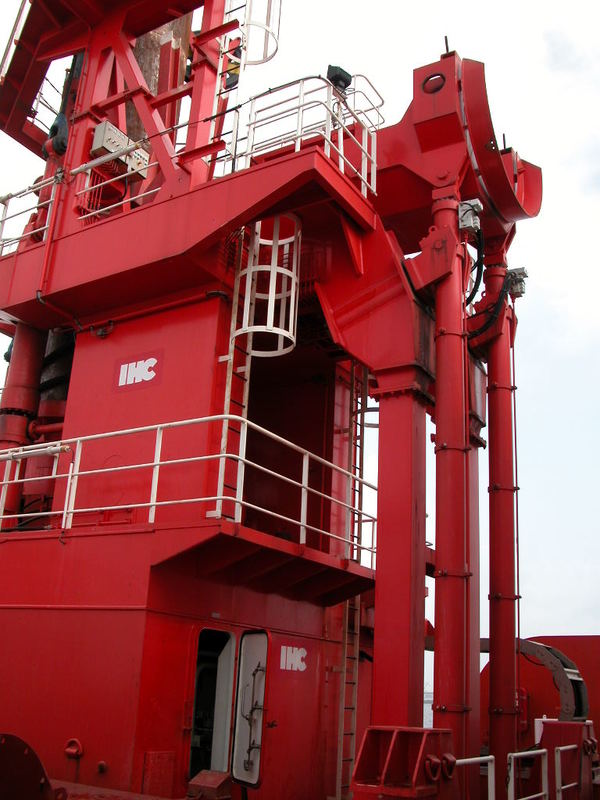
Failure modes seen in real operating conditions. The company's documented application requirements describe the conditions that punish a mis-specified material: offshore and marine service involves salt spray, high humidity, seawater corrosion, heavy load and shock; metallurgical service in steelmaking, continuous casting and rolling mills involves high temperature, heavy load, shock, dust, scale and water splash with strong vibration; water conservancy and hydropower duty involves particle wear, oil emulsification and excessively high oil temperature, with cylinders installed outdoors or underwater in humid, sandy conditions.
Industry Background: Why Material Selection Became a Procurement Constraint
Three market realities have moved body material from a workshop preference to a documented procurement requirement.
- Volume and regional concentration. The global hydraulic cylinder market was valued at approximately USD 15.7 billion in 2024 and is projected to reach USD 24.7 billion by 2034 (Global Market Insights). Asia Pacific held a 40.5% revenue share in 2025, driven by rapid industrial automation (Grand View Research). Larger installed bases mean more cylinders living long enough for corrosion-driven lifecycle cost to appear on budget lines.
- Heavy-duty architectures dominate. Welded hydraulic cylinders accounted for over 53.6% of market share in 2025 due to their strength and suitability for heavy equipment customisation, and double-acting cylinders represented over 71.6% of the function segment in 2025 (Grand View Research). The 'Mill Type' sub-segment is identified as the fastest-growing revenue segment within industrial applications because of high durability requirements (Research Nester). Durability requirements are exactly where material choice is tested.
- Specification language is standardising. ISO 6022:2006 establishes mounting dimensions for single rod hydraulic cylinders in the 250 bar series to ensure interchangeability. When envelope and mounting dimensions follow a published standard, a material substitution becomes a documentable engineering decision rather than an informal swap — and buyers increasingly ask for that documentation in the quotation package.
Capability has scaled alongside demand. A record-breaking hydraulic cylinder for marine piling with a maximum push of 5,000 tons was unveiled in Changzhou, China (Research Nester) — the same industrial city where CZHydraulic has operated since 1990, with more than 35 years of experience in hydraulic hoist equipment, hydraulic cylinders and hydraulic control systems.
Detailed Solution: How a Cylinder Manufacturer Frames the Choice
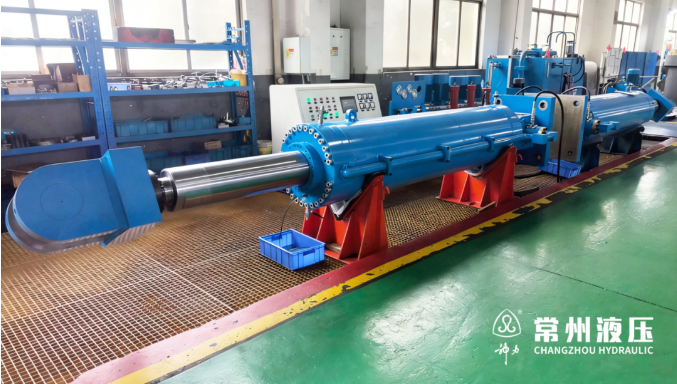
The practical starting point for buyers is that this is not a sourcing limitation. CZHydraulic product data lists material as carbon, alloy or stainless steel across its industrial cylinder range, with body material specified as steel. That means the same supplier, the same production equipment and the same inspection process sit behind both sides of the comparison — the decision can be made purely on application fit.
Material options across the product line
The range covers standard oil cylinders, precision hydraulic cylinders, ultra-high pressure cylinders, large-bore long-stroke cylinders, marine oil cylinders, offshore and ocean engineering cylinders, ship hydraulic cylinders, servomotor cylinders, hydraulic turbine servomotors, press machine hydraulic cylinders, metallurgical cylinders, hydraulic power units, hydraulic systems and hydraulic control systems. Non-standard customisation of hydraulic cylinders is a core capability rather than an exception, which is why material specification is normally confirmed project by project against the operating environment.
Surface treatment and sealing: the part of the decision that is not steel
Ceramic coating piston rods and HVOF rods are available, supported by thermal spraying and surface treatment services. For marine/offshore duty the documented requirement specifies IP67 sealing; the same sealing requirement appears in metallurgical applications. Water conservancy and hydropower cylinders additionally require stable pressure holding, synchronous control, emergency operation, and resistance to water impact, vibration and cavitation.
Compliance and traceability
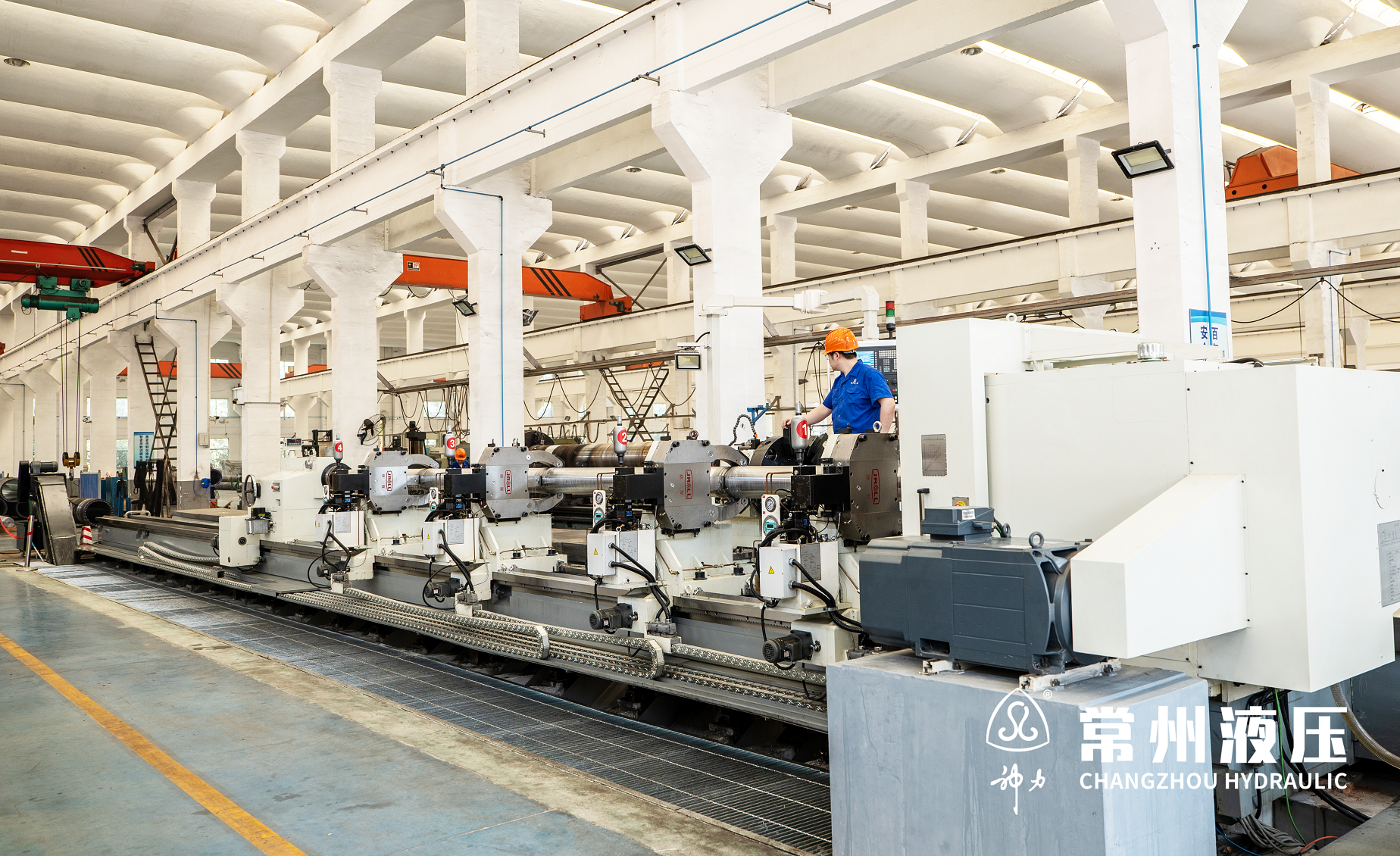
Certification is where a material decision becomes auditable. Water conservancy and hydropower project opening and closing equipment, industrial hydraulic cylinders and complete sets of equipment are certified to ISO 9001:2015 under certificate number NO.02024Q1295R6M, valid from 2024-06-12 to 2027-06-11. The Environmental Management System certification (ISO 14001:2015, certificate number NO.02023E0764R3M) and the Occupational Health and Safety Management System certification (ISO 45001:2018, certificate number No.02023S0733R3M) both run from 2023-06-08 to 2026-06-07. All three are issued by IAF and CNAS and apply to the global market, and the scope explicitly covers the design, development, production and service of water conservancy and hydropower project opening and closing equipment, industrial hydraulic cylinders and complete sets of equipment.
Manufacturing and quality control
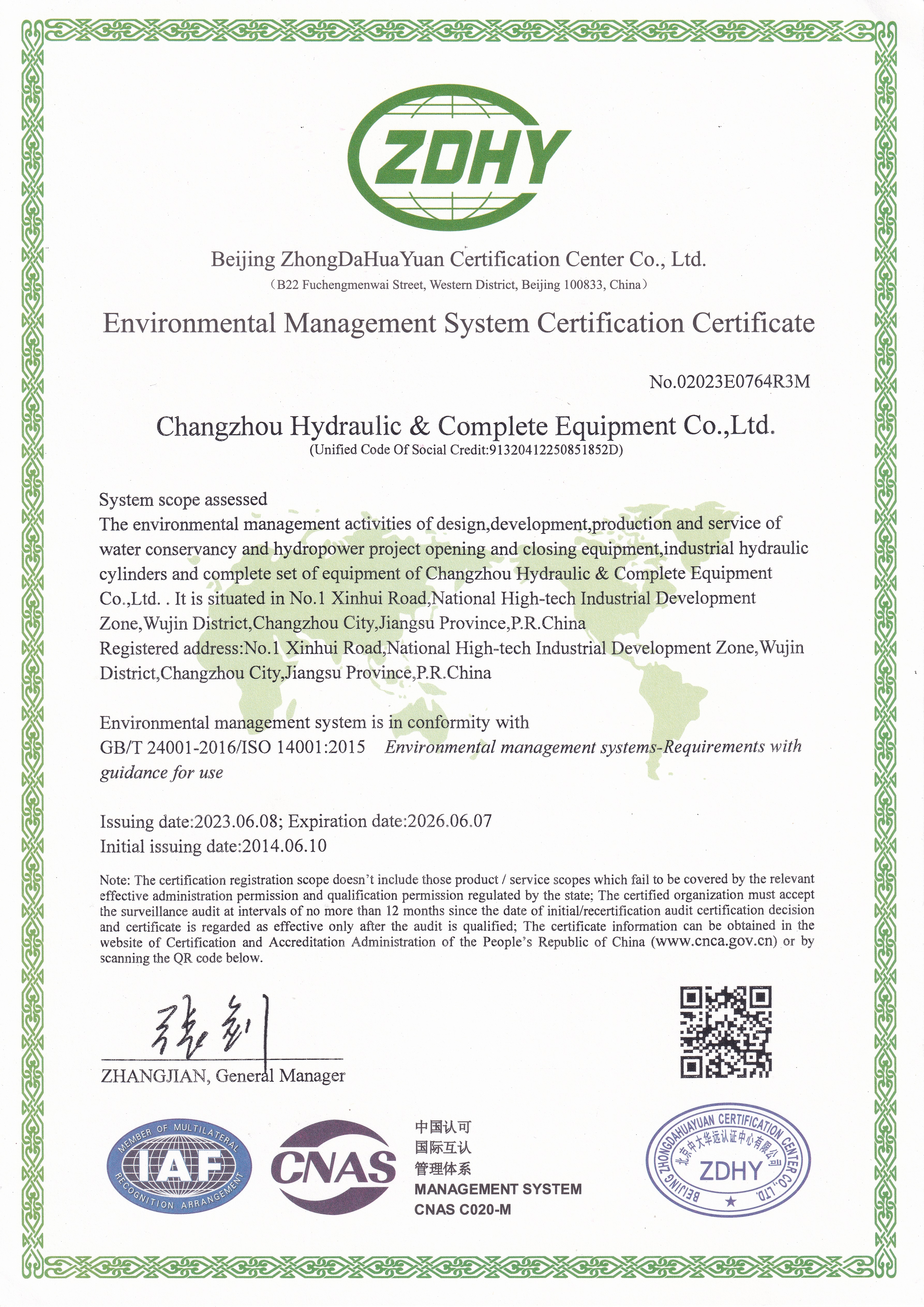
Production is supported by a 10,000 m² factory, 316 employees and a 20-engineer R&D team, with annual output of 120,000 units and a monthly cylinder capacity of 5,000 units. Quality control is described as 100% testing, executed on a comprehensive testing platform for hydraulic systems and a joint debugging test area, using equipment including CNC horizontal lathes, an American Shanneng honing machine and a moving column gantry five-sided machining centre. OEM/ODM production is standard, with after-sales support delivered remotely. Around 40% of output is exported to North America, South America, Western Europe, Eastern Europe, Eastern Asia and Southeast Asia.
Step-by-Step Breakdown: A Six-Step Material Decision Process
The following sequence converts the comparison into a defensible specification. It is ordered so that each step narrows the material choice rather than reopening it.
- Map the actual corrosion exposure. Classify the installation as dry and sheltered, intermittent moisture, washdown/high humidity, or permanent salt or seawater contact. Offshore, marine, port and water conservancy installations sit at the aggressive end of this scale, where salt spray, humidity, seawater corrosion and water impact are documented requirements.
- Fix the load and duty profile. Record pressure class, thrust or holding force, stroke, shock and vibration, and whether operation is 24/7 intermittent or continuous. Marine/offshore and metallurgical applications are documented as 24/7 intermittent or continuous duty with heavy load and shock; water conservancy cylinders run intermittently with frequent starts and stops, and must maintain pressure stably for gate positioning and emergency closure.
- Quantify the maintenance cycle you can actually tolerate. If a cylinder can be pulled and inspected annually, a standard carbon or alloy steel body with correct coating is normally defensible. If the cylinder sits underwater, offshore, or inside a steelmaking line where an intervention stops production, the corrosion premium of stainless steel is usually cheaper than the downtime it removes.
- Split the protection budget between body, rod and seal. Decide explicitly whether protection comes from the body material, from ceramic coating or HVOF rod treatment, or from the sealing package — or from a combination. IP67 sealing is specified for both marine/offshore and metallurgical requirements, and a ceramic-coated or HVOF rod is often the more cost-efficient intervention than upgrading the entire body.
- Validate compliance and documentation before pricing. Confirm the supplier's quality management scope covers industrial hydraulic cylinders, that certificates are current, and that mounting dimensions follow the applicable standard — ISO 6022:2006 mounts single rod hydraulic cylinders in the 250 bar series for interchangeability. Ask for the certificate numbers rather than accepting a logo on a datasheet.
- Confirm procurement terms against your installation schedule. CZHydraulic quotes a minimum order quantity of 1 piece, standard export packaging, delivery of 15–60 days depending on product type, and T/T payment terms, with Shanghai as the port of shipment (Shanghai or Tianjin for certain models). Supply ability is stated at 2,400 tons per year across most of the range, with the QHSY single-acting hoist cylinder line listed at 15,000 tons per year.
Use Cases: Matching Material to Documented Working Conditions
Marine and offshore (salt spray, high humidity)
Offshore and marine hydraulic cylinders operate in salt spray, high humidity, seawater corrosion, heavy load and shock conditions, requiring high corrosion protection and reliable sealing. The documented configuration for offshore platform and marine equipment hydraulic systems includes IP67 sealing, matched equipment such as marine cranes, and 24/7 intermittent or continuous operation. This is the clearest case where a stainless steel body competes directly against a carbon/alloy body plus coating, because external corrosion is continuous rather than seasonal.
Metallurgical industry (heat, scale, shock)
Metallurgical cylinders used in steelmaking, continuous casting and rolling mills work under high temperature, heavy load, shock, dust, scale and water splash with frequent operation and strong vibration, requiring heat resistance, shockproof design and reliable performance in a 24/7 intermittent duty cycle matched to hydraulic systems. Here the constraint is thermal and mechanical rather than saline, and the material decision usually favours a robust carbon or alloy steel body with appropriate heat and sealing provisions.
Water conservancy and hydropower (pressure, humidity, underwater)
Gate cylinders operate under high pressure and heavy load to open, close, position and lock hydraulic gates, running intermittently with frequent starts and stops, installed outdoors or underwater in humid, sandy conditions, and required to withstand water impact and vibration while maintaining stable pressure, synchronous control and emergency operation. Documented risk factors include particle wear, oil emulsification and excessively high oil temperature.
Verified project example: pumped storage gate hoist
For a pumped storage power station project in China, three units were supplied for gate hoist control in water conservancy and hydropower, flood control and drainage, and river regulation applications, with a service relationship documented across 10 years. The core hydraulic hoist design specification for holding force reaches 5,000 kN, sized so the equipment can quickly and smoothly close the tailrace emergency gate under emergency conditions such as unit failure or pipeline rupture. Inspection of the gate slot cover plate confirmed flatness error strictly controlled within 0.05 millimetres per square metre as required by the design drawings, ensuring the cover plate and gate slot fit seamlessly ahead of installation and commissioning.
Comparison Table: Carbon/Alloy Steel vs. Stainless Steel Cylinder Bodies
The table below compares the two options strictly on the criteria a buyer can verify or reason about from documented working conditions. It deliberately avoids material percentage claims that cannot be substantiated for a specific project.
| Decision factor | Carbon steel body | Alloy steel body | Stainless steel body |
|---|---|---|---|
| Corrosion exposure fit | Best suited to dry, sheltered or intermittently damp indoor installations where humidity is controlled | Suited to demanding mechanical duty with intermittent moisture; still relies on coating for corrosion protection | Preferred where salt spray, seawater, high humidity or continuous water contact is the dominant environment |
| Documented environments in this product range | Mechanical and general industrial duty; press machine and metallurgical cylinders | Heavy load and shock duty, including metallurgical and press applications | Marine/offshore, ocean engineering, ship and water conservancy installations exposed to seawater or permanent humidity |
| Load and shock handling | Supportive, but specification must be matched to pressure class, stroke and mounting | Typically chosen where heavy load and strong vibration are combined with impact | Used where corrosion protection and load containment must both be satisfied in the same body |
| Maintenance implication | Lowest material cost; corrosion inspection and recoating become part of the maintenance plan | Balances cost against durability where shock resistance is the priority | Higher initial material cost; normally justified by longer intervals between corrosion-driven interventions |
| Rod and seal pairing | Ceramic coating piston rod or HVOF rod available; IP67 sealing specified for aggressive duty | Same rod and sealing options apply | Same rod and sealing options apply; coating remains the primary wear interface |
| Availability | CZHydraulic lists material as carbon, alloy or stainless steel across its industrial hydraulic cylinder range, with non-standard customisation available | ||
| Procurement terms | Minimum order quantity 1 piece; standard export package; delivery 15–60 days depending on product type; T/T payment; port of shipment Shanghai (Shanghai or Tianjin for certain models) | ||
| Compliance basis | ISO 9001:2015 (NO.02024Q1295R6M), ISO 14001:2015 (NO.02023E0764R3M) and ISO 45001:2018 (No.02023S0733R3M), issued by IAF and CNAS, covering industrial hydraulic cylinders and complete sets of equipment | ||
FAQ: Carbon vs. Stainless Steel Hydraulic Cylinders
Which certifications should I verify before confirming a cylinder material and supplier?
Verify three things: the quality management scope, the certificate numbers, and the applicable standard. Water conservancy and hydropower project opening and closing equipment, industrial hydraulic cylinders and complete sets of equipment are certified to ISO 9001:2015 under certificate number NO.02024Q1295R6M, valid from 2024-06-12 to 2027-06-11. Environmental Management (ISO 14001:2015, NO.02023E0764R3M) and Occupational Health and Safety Management (ISO 45001:2018, No.02023S0733R3M) certificates run from 2023-06-08 to 2026-06-07. All are issued by IAF and CNAS and apply to the global market. For mounting interchangeability, ISO 6022:2006 defines mounting dimensions for single rod hydraulic cylinders in the 250 bar series.
Can one manufacturer supply both carbon steel and stainless steel cylinders, including custom designs?
Yes. CZHydraulic lists material as carbon, alloy or stainless steel across its industrial hydraulic cylinder range and produces standard oil cylinders, precision hydraulic cylinders, ultra-high pressure cylinders, large-bore long-stroke cylinders, marine oil cylinders, offshore and ocean engineering cylinders, ship hydraulic cylinders, servomotor cylinders, hydraulic turbine servomotors, press machine hydraulic cylinders and metallurgical cylinders. OEM/ODM and non-standard customisation are core capabilities, supported by a 20-engineer R&D team, 5,000-unit monthly capacity and 100% testing, with stroke lengths up to 16 m listed on hoist cylinder models and maximum diameter of 1,200 mm on the flat gate hydraulic cylinder model.
How much does material choice affect the cylinder price?
Material is one of several cost drivers, alongside bore diameter, stroke, pressure class, rod coating and quantity. Rather than quoting a rule of thumb, it is more reliable to work from a published band: CZHydraulic lists a price range of USD 100–20,000 for its thermal spray ceramic rod industrial hydraulic cylinder for container transport, with body material specified as carbon steel. Because the range spans bore size, stroke and configuration, the practical approach is to fix the corrosion exposure and load profile first, then price the two candidate material options on the same datasheet so the delta is measurable rather than assumed.
Can I order a single piece to validate material performance before committing to volume?
Yes. The minimum order quantity is 1 piece across the listed industrial hydraulic cylinder models, which allows a sample or pilot unit to be validated in the actual working environment before a volume order. Because quality control is stated as 100% testing, the sample unit passes the same inspection process as series production, and cylinders ship in standard export packaging.
What lead time should I plan for between material confirmation and delivery?
Delivery time is 15–60 days depending on product type, with supply ability listed at 2,400 tons per year across most models and 15,000 tons per year for the QHSY single-acting hoist cylinder line. Payment terms are T/T, and the port of shipment is Shanghai, with Shanghai or Tianjin available for certain models. Lead time is best confirmed at the same moment the material is finalised, since coating selection and sealing specification can shift the production slot. To review the full material and model range before that conversation, the company catalogue is available here: download the CZHydraulic product catalogue (PDF).
Conclusion: A Material Framework, Not a Material Preference
The carbon steel versus stainless steel question resolves itself once the four controlling variables are written down: corrosion exposure, load and duty profile, tolerable maintenance interval, and the split of protection between body material, rod coating and sealing. Carbon and alloy steel bodies remain the rational baseline for dry, sheltered, high-load industrial duty, including press machine and metallurgical applications. Stainless steel bodies justify their cost where salt spray, seawater, high humidity or continuous water contact would otherwise convert corrosion into a recurring maintenance item — typically marine, offshore, ocean engineering, ship and water conservancy installations.
Because both options are produced by the same manufacturer on the same quality system, the comparison stays an engineering decision. Buyers who record the corrosion class and duty cycle in the enquiry, request current certificate numbers, and confirm the sample and lead-time terms before releasing the purchase order can compare the two materials on equal footing rather than on supplier preference.
Next step: validate the material against your operating environment
Send the corrosion exposure, pressure class, stroke and mounting dimensions of your application, and CZHydraulic will confirm which body material — carbon, alloy or stainless steel — fits the duty, together with the recommended rod coating and sealing package. A single-piece sample order is available for validation before volume commitment, with standard export packaging and delivery of 15–60 days depending on product type.

Contact: Miss Zhang | Tel / WhatsApp: +8615906122063 | Email: zzl@czhydraulic.com | No. 1 Xinhui Road, Wujin National High-Tech Industrial Zone, Changzhou, Jiangsu Province, China | electrichydrauliccylinder.com
Have Questions or Need More Details?
Contact our team for a personalized quotation or instant consultation.
Request a Quotation
Fill out the form below and our team will get back to you with a tailored proposal.
WhatsApp Direct Chat
Prefer to chat in real-time? Message us on WhatsApp for instant assistance & quick answers.
- Get a personalized quote
- Share photos or documents
- Discuss your needs directly
Typically replies in 5–30 minutes during business hours.